
Is Your Citizenship Application Taking Too Long? Understanding ATIP Notes
If months have passed without meaningful updates on your Canadian citizenship application, you’re not alone—and there’s a way to find out what’s really happening behind the scenes. Citizenship ATIP notes provide detailed insight into your application status, revealing officer assessments and processing delays that aren’t visible in your online tracker.
Understanding ATIP and GCMS Notes
When you submit a citizenship application to Immigration, Refugees and Citizenship Canada (IRCC), officers track every detail in their Global Case Management System (GCMS). Through an Access to Information and Privacy (ATIP) request, you can access these same internal records that officers use to evaluate your file.
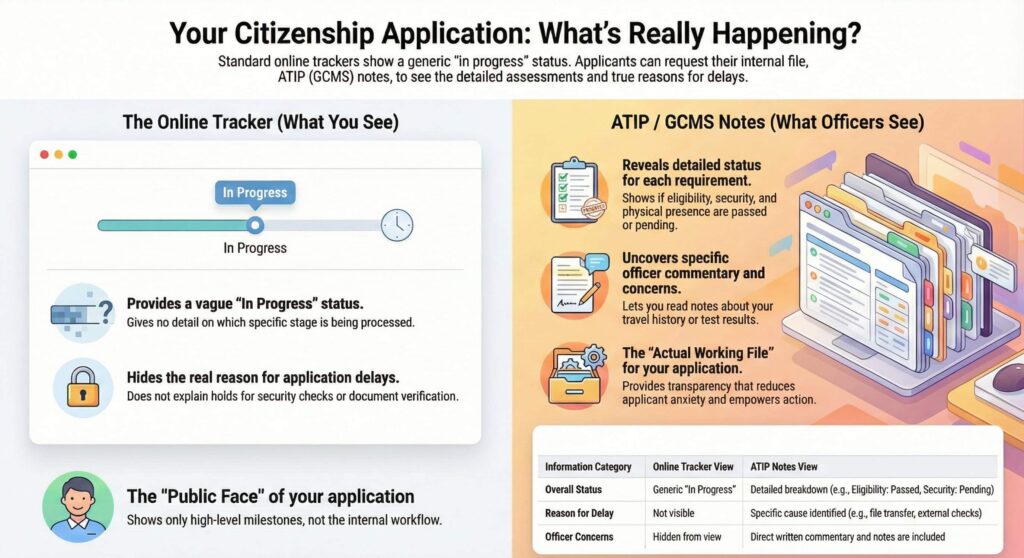
Think of it this way: your online citizenship tracker shows you the “public face” of your application, while ATIP notes reveal the officer’s actual working file—complete with assessments, concerns, and processing stages.
ATIP vs. GCMS: What’s the Difference?
These terms are often used interchangeably, but they’re technically different:
- ATIP refers to the legal framework and request process under Canadian law
- GCMS notes are the actual records you receive through that process
When IRCC modernized its systems in 2010, GCMS replaced the older CAIPS system, but the principle remains the same: giving applicants visibility into their own files.
What You’ll Find in Your Citizenship ATIP Notes
Your notes typically include several key sections that reveal far more than the standard online tracker:
| Section | What It Shows |
|---|---|
| Application Stage | Where your file currently sits in the processing queue |
| Officer Commentary | Written observations about your eligibility, concerns, or next steps |
| Physical Presence Assessment | How officers calculated your days in Canada |
| Test Results | Language ability and citizenship knowledge test evaluations |
| Security Screening | Status of background, criminality, and security verifications |
| Document Requests | Any additional materials requested and your responses |
| Processing Delays | Internal explanations for why your file may be on hold |
| File Movements | Transfers between IRCC offices with dates |
These officer-level details often explain delays and concerns that never appear in your online account.
Why ATIP Notes Matter for Citizenship Applicants
Uncovering Your True Application Status
The online tracker might say “in progress” for months, but ATIP notes show whether each requirement—eligibility, physical presence, language, prohibitions, and background checks—is not started, in progress, completed, or flagged for review.
Understanding Processing Delays
Applications stall for many reasons, and your notes often reveal the specific cause:
- Background or security screenings taking longer than average
- Waiting for verification from external agencies or departments
- File transfers between offices due to workload distribution
- Questions about documentation that needs clarification
- Calculation discrepancies in physical presence requirements
This insight helps you decide whether to wait patiently, submit additional documents, or escalate through your Member of Parliament.
Reading Officer Concerns
Perhaps the most valuable part of your notes is the officer’s written commentary. They might note:
- Questions about your travel history or entry/exit dates
- Concerns about gaps in your physical presence calculation
- Observations from your citizenship test or interview
- Minor inconsistencies between your PR and citizenship applications
Knowing these concerns early lets you prepare explanations or gather supporting evidence before they become bigger issues.
Responding to IRCC Requests Effectively
When IRCC asks for additional documents, your ATIP notes often reveal what triggered the request. This eliminates guesswork and ensures your response directly addresses the officer’s specific concerns.
Supporting Professional Review
Immigration lawyers and consultants regularly use ATIP notes to evaluate cases. The notes help them:
- Identify potential refusal risks early
- Prepare targeted legal submissions
- Determine if judicial review is warranted
Making Sense of “Ghost Updates”
Sometimes your online profile updates without explanation—these “ghost updates” signal backend activity. ATIP notes decode these mysterious changes by showing whether they represent meaningful progress (like an eligibility pass) or just administrative actions.
Reducing Anxiety
Citizenship processing stretches across many months. ATIP notes provide transparency that transforms worry into understanding, showing you exactly where things stand and whether any action is needed from you.
Sample Notes: What to Expect
Here’s a typical example of what you might see:
Application Status: In Progress
Physical Presence: Passed
Knowledge Test: Passed
Language Assessment: Passed
Criminality: Passed
Prohibition: Passed
Security: In Progress
Primary Office: CPC-Ottawa

Officer Note: "Knowledge assessment completed. Physical presence requirement verified. Language score confirmed. File awaiting security screening completion. No applicant action required."
This example shows a common scenario: most checks are complete, but the application is paused for security screening—a procedural step that doesn’t indicate problems.
When to Request Your Notes
The optimal time to request ATIP notes is after receiving your Acknowledgement of Receipt (AoR). At this point:
- Officers have begun reviewing your file
- Meaningful assessments and comments are being recorded
- Your application number is available (required for the request)
Notes are particularly valuable if your online tracker shows minimal progress after several months, or if IRCC has sent you a request for additional information.
Who Can Request Notes
Any of the following can request ATIP notes:
- The citizenship applicant themselves
- Anyone acting on their behalf with proper written consent
- Immigration consultants or lawyers representing the applicant
We assist both individual applicants and immigration professionals with their ATIP requests.
What Your Citizenship ATIP Notes Will Contain
Expect to find citizenship-specific information including:
- Your personal details (name, UCI, application dates, processing office)
- Eligibility assessments (1,095-day residency requirement, language level CLB 4+, test status)
- Background checks (security through CSIS, criminality through RCMP, current status)
- Dated officer comments explaining issues or next steps
- Verification records and additional document flags
- File transfer history and webform submissions
Some sections may be redacted for security (sections 15/16) or privacy (section 19) reasons—this is standard practice and doesn’t necessarily indicate problems.
How to Interpret Your Notes
Follow this approach when reviewing your notes:
- Start with the summary page – Check the status fields for Eligibility, Criminality, and Security
- Review status indicators – Match your timeline to “passed,” “in progress,” or blank fields
- Read officer notes carefully – Most recent entries appear first; look for specific concerns
- Compare to your timeline – Align notes with events in your application journey
Requesting Your Notes
The process is straightforward:
- Click “Order” and complete a short online form with your application details
- Submit proper consent if someone else is requesting on your behalf
- Track your request through our secure dashboard
- Receive your notes electronically when ready
This streamlined approach eliminates complicated government portals and reduces errors that could delay your request.
Processing Time
IRCC must respond to complete ATIP requests within 30 calendar days under the Access to Information Act and Privacy Act. Many straightforward requests are fulfilled within this timeframe. However, IRCC may extend the deadline when:
- The request involves a large volume of records
- Consultation with other departments is required
- High workload periods affect processing capacity
Limitations of ATIP Notes
While ATIP notes are valuable, they have constraints worth understanding:
Information That May Be Withheld
Certain details are legally protected and must be redacted before release:
- National security-related information
- Active law enforcement or background investigations
- Third-party or proprietary commercial information
- Personal information about other individuals
Sections may appear heavily blacked out—this is routine legal compliance, not necessarily a sign of problems with your application.
Important: Redactions shouldn’t discourage you from requesting notes. Even with some information removed, the notes still reveal valuable insights about your application’s progress.
Frequently Asked Questions
What exactly are GCMS/ATIP notes for citizenship?
GCMS notes are IRCC’s internal processing records. When requested through ATIP, they reveal officer assessments, application status, background checks, and delay explanations not visible in your online tracker.
Do citizenship applications benefit from GCMS notes?
Yes. The notes provide officer-level details about your file, including eligibility determinations, physical presence calculations, test results, and internal concerns—especially useful during unexplained delays.
When should I request notes?
After receiving your Acknowledgement of Receipt (AoR), which confirms officers have begun reviewing your file and recording assessments.
How long until I receive my notes?
IRCC must respond within 30 calendar days by law, though extensions may apply for complex files or high-volume periods.
Who can request notes for my citizenship application?
You can submit a request directly, or authorize someone to request on your behalf with proper consent.
Why are parts of my notes blacked out?
Redactions protect national security, internal government processes, and third-party privacy—these are legally required and normal.
Can notes explain my citizenship delay?
Yes. Notes often reveal delays from pending background checks, office transfers, missing documents, or officer concerns, helping you decide whether to wait or take action.
How does this service simplify the ATIP request process?
Using a professional service handles consent forms, submission, tracking, and delivery through a secure dashboard, eliminating the need to navigate government portals directly.
What’s the difference between GCMS and ATIP notes?
ATIP is the legal request process under Canadian law, while GCMS notes are the actual internal records you receive from that request.
Ready to understand what’s really happening with your citizenship application? Order your ATIP notes and get the transparency you deserve.